
The Art of Marginalia: Capturing Thoughts in Books

The author discusses their practice of annotating books with marginalia, seeing it as a way to capture thoughts, questions, and connections while reading. These annotations create a personalized record of their responses to the text, akin to preserving life’s moments through photographs or letters, revealing individual perceptions that may not resonate with others.

Whether a marginal note, comment, reference, or illumination, books I have read multiple times will be adorned. I know. I hear the muffled voices, “You do NOT write in books. Just does NOT happen.” I must admit that many of the books in my library have been adorned with marginalia.

These notes are questions I capture as I read. To be answered later or serve as rhetorical questions requiring contemplation of the passage. They are links to other passages, definitions, or exemplars. There are multiple entries along the margins. Reading a book at different times will evoke similar or different comments. The passage evolves into an annotated and personally curated artifact. It links ideas in a continuum. Alternatively, it adds a deeper and more interconnected journal of my reaction to a specific passage.

Several books in my library are embellished with that and much more. Some have note cards, newspaper clippings and pieces of paper between a page here and there. My own PKM, I guess.

None of these personally illuminated texts find their place anywhere except my library. Their use, relevance and even meaning elude some. It is a glimpse into how I read a book. You start to see my thought processes, my responses to the passages and get a glimpse into me. You comprehend my marginalia. Or you dismiss it all as doodles on the page.

All that being said, it’s like life. We each have an annotation in our lives. Sometimes, it exists and is preserved in a photograph. Sometimes, by letters we send and those we get. It all makes sense to you. But to others, it just doesn’t click.
A little Thoreau

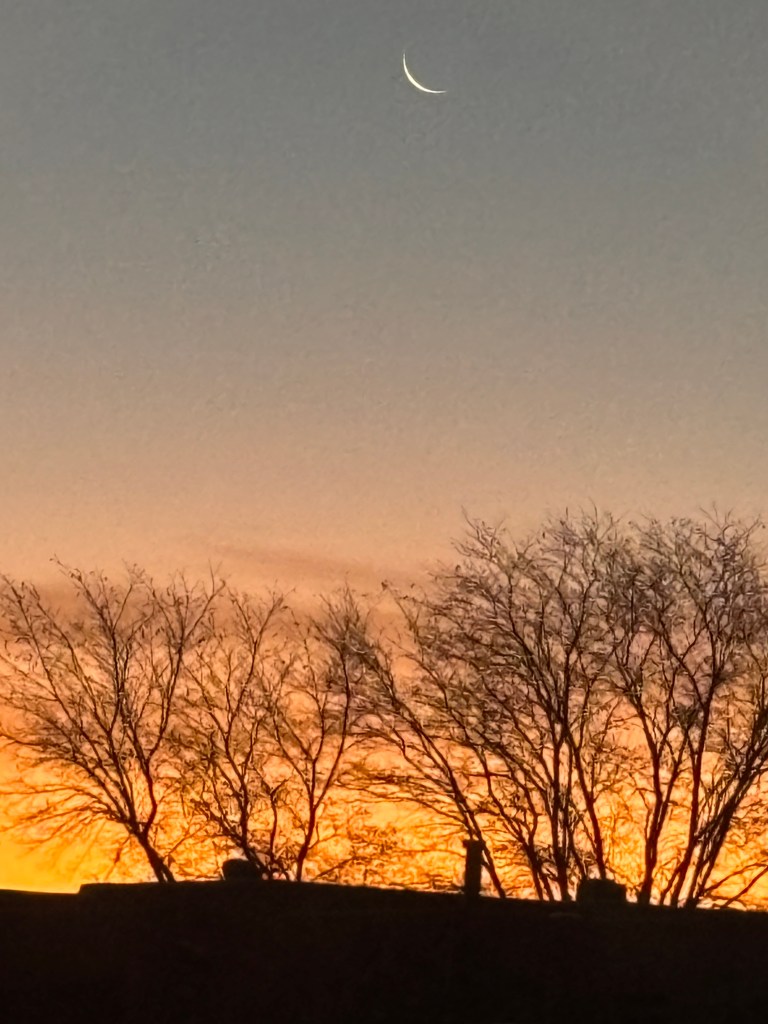
The post reflects on the beauty and significance of each morning, emphasizing the opportunity for renewal and presence. It highlights a memorable sunrise in New Mexico, encouraging a focus on the present rather than the past. The author also quotes Thoreau, reinforcing the idea of awakening to new possibilities each day.

Every morning was a cheerful invitation to make my life of equal simplicity, and may I say innocence, with Nature herself. -Henry David Thoreau, Walden, 1854.

Not sure how you approach the morning, but let me share mornings from where I watch. I’ve seen sunrise in New Mexico that just confidently welcome the day. A bright array of colors starts slowly peeking over the horizon. It is such a spectacle of visual elements that missing it would seemingly deprive you of the blessings from God.

Sunrise in New Mexico. November 29, 2024, 6:23 AM.

Sunrise in New Mexico on November 29, 2024 was one that just made me see even more evidence of the start of the day. The series of events that must occur. Surely this can be our best invitation to welcome and start the day.

Morning is when I am awake and there is a dawn in me. – Henry David Thoreau, Walden, 1854

As the day begins anew with the rising of the sun, and the setting of the moon, there should be, I believe, a likened event where each day is a new opportunity, I could easily dwell on the past; what worked, what didn’t, opportunities taken, and missed. As a Christian, my focus should not be my past, but my present – what am I doing now. Not what I plan to do later.

We must learn to reawaken and keep ourselves awake, not by mechanical aids, but by an infinite expectation of the dawn, which does not forsake us in our soundest sleep. Henry David Thoreau, Walden, 1854.

We know that daybreak occurs. Ready or not, the sun also rises. To wake each day, to reawake day after day; as the sun rises so to do we.

( Sunset follows in the next post )

\